The Group operates in the renewable and clean energy sector and is committed to balancing business growth, environmental stewardship, and social responsibility under a sustainable development framework that comprehensively considers impacts on stakeholders throughout the business value chain.
The Group recognizes that long-term value creation and competitiveness require a thorough understanding of the economic, environmental, and social matters that are significant to its operations and to the expectations of stakeholders across all sectors. The Group therefore conducts a systematic material topics analysis to identify, prioritize, and assess matters that affect its business operations and sustainable organizational development.
This analysis serves as an important mechanism for supporting the Group’s strategic direction, policy development, and sustainability planning. It helps align the Group’s approach with the business context, risks, opportunities, and potential future changes, while strengthening stakeholder confidence and creating sustainable shared value for stakeholders and society as a whole.
Sustainability Material Topics Analysis Process
The Group conducts a systematic sustainability material topics analysis, beginning with the identification and classification of internal and external stakeholders connected with its business operations. This provides the basis for considering stakeholder expectations, concerns, and matters that may be affected by the Group’s operations. The process covers 10 key stakeholder groups.
The Group then compiles and selects sustainability matters relevant to the renewable energy business. Considerations include the business context, various information sources, business risks and opportunities, legal and regulatory requirements, stakeholder expectations, and sustainability practices in the energy industry. This process resulted in the identification of 23 sustainability matters.
The Group also conducts a comprehensive assessment of the impacts associated with each matter, covering both actual and potential future impacts. The assessment considers positive and negative impacts across governance and economic, social, and environmental dimensions, including human rights impacts that may arise from the Group’s operations or business relationships.
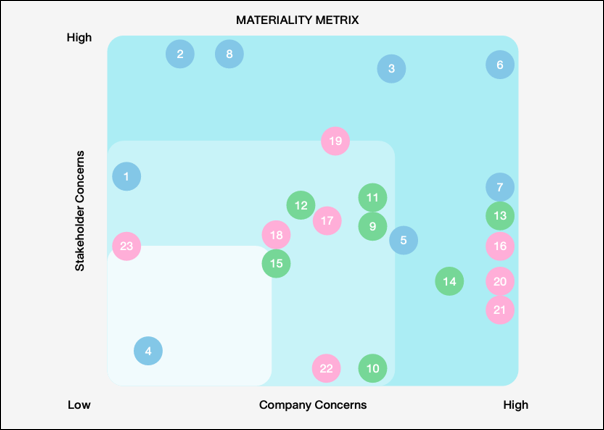
The assessment results are analyzed to prioritize the matters by considering both their significance to the Group’s business operations and strategy and their significance to stakeholders. Matters rated as highly significant are designated as material sustainability topics for disclosure and as a framework for establishing the Group’s sustainability management approach.
Finally, the Group reviews and validates the appropriateness of the material sustainability topics with relevant management to ensure that the selected topics comprehensively and appropriately reflect significant impacts on business operations and stakeholders. The validated results serve as a reference framework for disclosure and for the development of the Group’s sustainability strategies, policies, and action plans.
Sustainability Materiality Matrix
Summary of Material Sustainability Topics
| Governance and Economic Dimension (GE) |
|
| Environmental Dimension (E) |
|
| Social Dimension (S) |
|